
Will TV Survive? New Research Reveals Younger Generation Turning Away
Will TV survive in a world where younger generations are turning away from traditional viewing? New research reveals a growing divide between digital platforms and TV.
As a kid, my mum used to warn me that too much TV would turn my eyes square.
Luckily they haven’t. Although nowadays I think they are more likely to turn cross-eyed as I find myself spending longer than ever trying to decide what to watch on the box.
That’s after an eternity of choosing between Netflix, Disney, Amazon, Sky, YouTube or even a TV licence.
When I do eventually decide I have to master the art of not spilling any tea on my laptop that’s playing Mr Beast.
Or on the phone glued to my other hand that is playing TikTok videos, it has convinced me I will like. All whilst Netflix is doing what it does best, keeping me prisoner to the sofa. As I struggle with content overwhelm I think back to simpler times when TV aerials were more than just ‘pigeon perches’.
They provided us with just 5 channels to choose from. Back then it was easier to choose to go outside and complain that there was nothing good on telly. So is more content is better?

What Channel 4's Research Reveals
Well, according to a recent study by Channel 4, the answer may be no.
Their research suggests that the average person watches an incredible 5 hours of video daily. All this viewing might be doing more damage than just eye strain, it’s causing some serious emotional distress.
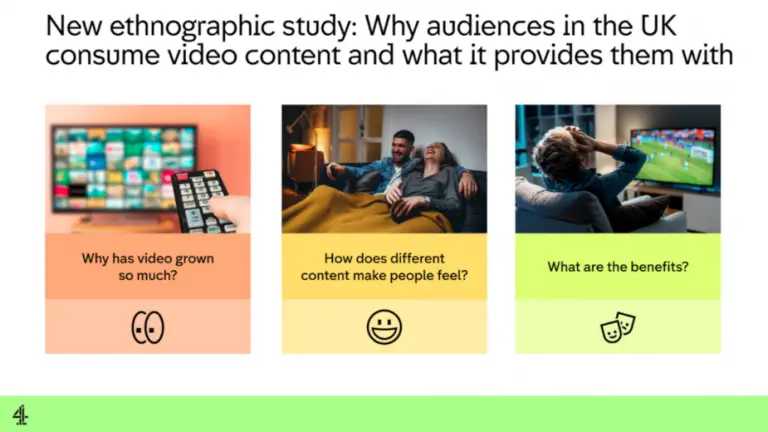
Wanting to better understand modern viewing habits Channel 4 embarked on an ambitious research project not just to map out the new ‘video day’ but to answer these three questions:-
- Why has video grown so much that it now absorbs people’s time more than ever before?
- How do types of content make people feel and what are their emotional reactions?
- What benefits do they get from watching?
Their findings revealed some fascinating insights into our complicated relationship with endless entertainment and the concept of ‘video overload’. So what can we learn from all this?
Key Findings
Channel 4’s research uncovered some eye-opening data on how viewers consume and emotionally react to video content today. A few of the headline numbers:-
- People are watching a staggering 5+ hours of video daily on average. Short-form clips have piled on top of long-form programming.
- About 25-45% of viewing time is now short-form content depending on the age group. Younger audiences favour bite-sized videos.
- Many viewers feel anxious about ‘overload’ and ‘lack control’ over algorithmic recommendations. The initial thrill of auto-playing clips fades fast and turns into mindless binge-watching.
- In contrast, human-curated long-form is valued for relaxation and intentionality. Viewers appreciate public service broadcasters tailored for them.
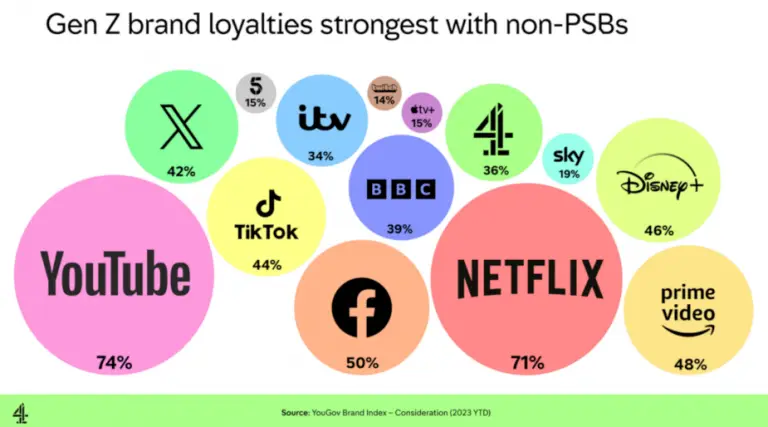
- But younger generations have weaker connections to legacy broadcast brands such as BBC and ITV. Their loyalties lie more with digital streaming services such as Netflix, Disney and Amazon Prime.
- While ‘viewing overload’ can cause anxiety, human-curated long-form can still provide meaning amidst the barrage of algorithmic dopamine-fueled snacks. So broadcasters have an opportunity to stay relevant if they can capture younger eyeballs.

Four types of Viewing
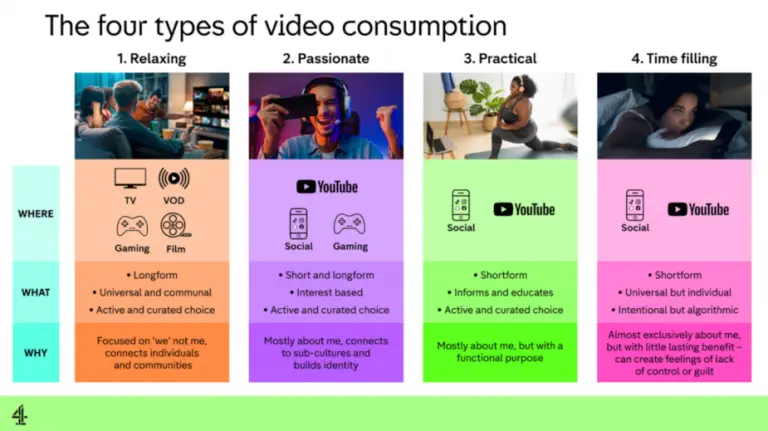
The research identified 4 types of video consumption:-
- Relaxation: Long-form videos, a series, a film or a gaming session helps fill this void and lets people settle down to ease their mind.
- Passion: This often comes in the shape of social media or gaming and can help connect with other people even if remotely.
- Practical: The University of Youtube. Watching videos to learn used to be a treat (maybe a bit strong) at school, now, especially on YouTube it is a form of schooling. Courses are popping up everywhere online about every subject and even linear TV shows inspire us to tackle property renovation, garden make-overs, business transformations and learn how to cook. It’s a great way to learn.
- Boredom Bashing: There is never a dull moment when you can whip out your phone and doom scrolling commencing. This is often short-form and is thought to lead to feelings of guilt and not being in control.
Algorithmic vs Human Curation
Channel 4’s research highlighted a big difference between algorithmic and human-curated content.
- When the algorithms took charge, viewers felt anxious and out of control, like their downtime was being invaded.
- The initial thrill of an autoplay video often left them feeling empty afterwards due to a spike and crash in dopamine levels.
- In comparison, human-curated content brought more relaxation and positivity.
- Editors handpick what they think audiences will enjoy, rather than just chasing watch time.
- Interestingly, when participants had to give up video for a day, most opted for human-curated public broadcaster content for their one ‘cheat’ viewing, craving that human touch.
The study suggests that while data and algorithms play a role, they can’t fully replace good old human judgment and creativity in curating video content just yet. So maintaining a balance between both technology and the human touch in making personalised recommendations will be key moving forward.
What this research means
Channel 4’s study reveals some vital takeaways for the TV industry.
Most importantly, it demonstrates that more content does not equal better viewing experiences. Thoughtless overconsumption of algorithmic videos leaves audiences feeling drained. This signals that quality and curation remain vital.
For content creators, it emphasises the need to focus on relevance over volume.
Viewers crave intentional, tailored programming from trusted sources. Public broadcasters should double down on this role while also expanding distribution to reach younger demographics.
Overall, the research warns against complacency in meeting audiences’ needs.
As competition and choice explode, maintaining an emotional and personal connection will be key.
There are still opportunities for broadcast TV to inform and inspire, not just fill time. However, adapting programming and partnerships to the new realities of a fragmented and shortening attention time will determine who flourishes.
The race is on.
To Wrap Up
Channel 4’s research shines an interesting light on the rapidly evolving world of video content.
Their findings make it clear that while we are consuming more content than ever, across a multitude of platforms, not all of this viewing is equal. With more content being produced than ever before we must be mindful about what we watch, not just allowing the algorithm to make the choice for us (guilty as charged).
Thoughtlessly grazing on a never-ending stream of algorithmic recommendations can leave us feeling anxious and dissatisfied if we let it take over.
As for Channel 4, they need to double down on attracting younger audiences in an ever more competitive landscape, luckily they have made a good start with 4.0. Now, for me it’s time to finally walk the dog. I might also see what YouTube recommends for me to watch on my phone while I do so.