The Patient Journey Video Strategy: How to Match Video Content to What Patients Need
Why most healthcare videos miss the mark
Most healthcare video content doesn’t work as hard as it should. It’s often generic, out of sync with the patient experience, or trying to do too much at once.
Introducing the Patient Journey Video Strategy
"Meet them where they are. Move them where they need to go."
— Ron Jeffries
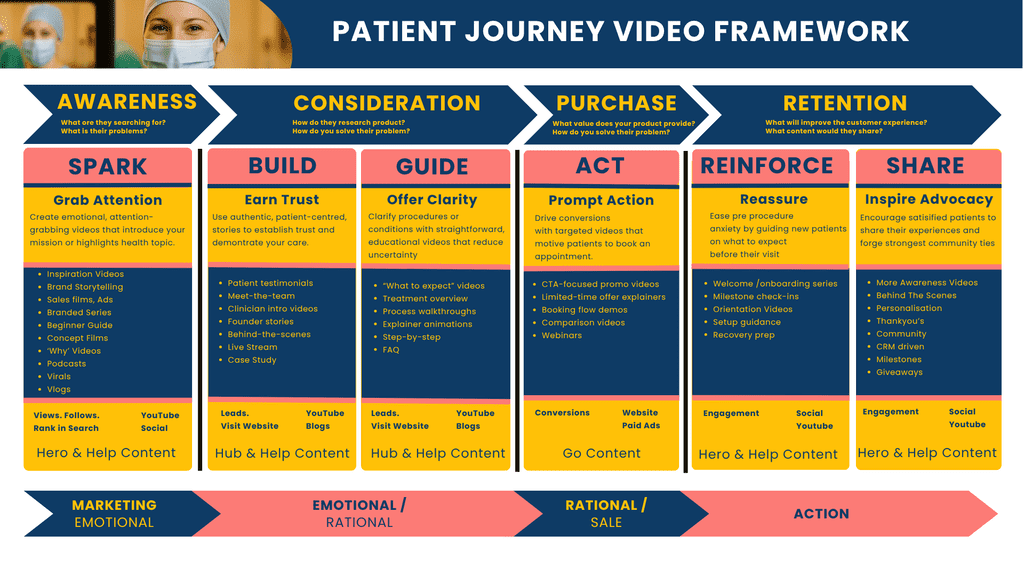
The Patient Journey Video Strategy is a behavioural map, not a content checklist. Each of its six stages aligns with a specific emotional mindset, and each is backed by a proven video format.
Spark – Grab attention through emotion and relevance
Build – Earn trust with human-centred stories
Guide – Demystify decisions with clarity
Act – Prompt confident action
Reinforce – Reassure and retain
Share – Inspire storytelling and advocacy
Now let’s explore each stage with examples.
Stage 1: Spark – Grab Attention
Funnel Stage: Awareness (Top of Funnel)
This is the top of the funnel, where patients are only just becoming aware of their problem or your service. Your goal here is to disrupt their thinking with relevance, empathy or curiosity.
It’s not about selling, it’s about sparking recognition and emotional resonance.
Patient mindset: “That feels like me.”
Formats: Brand film, teaser reel, values-led ads
Video goal: Interrupt the scroll. Create an emotional connection.
Example: NHS: “That Feeling”
This joyful 30-second ad likens breast screening to the universal comfort of removing a bra at day’s end. It’s warm, culturally spot-on, and subtly delivers a life-saving message.
The Lesson: If you’re a clinic or hospital, lead with real-life emotional triggers. Aim to feel relevant, not corporate.
Stage 2: Build – Earn Trust
Funnel Stage: Consideration (Middle of Funnel)
Here, patients are actively researching or comparing services. They want to feel understood and reassured. Video content at this stage needs to build credibility, relatability and personal connection.
Patient mindset: “They understand what I’m going through.”
Formats: Testimonials, team intros, patient stories
- Video goal: Show empathy. Prove you’re human.
Example: Duke Health – Eddie Zimmerman’s Kidney Transplant Story
This short doc follows a young musician denied a second transplant elsewhere until Duke stepped in. His story, told alongside the care team, is raw and hopeful.
The Lesson: Trust is built through vulnerability. Don’t just showcase outcomes, share the journey.
Stage 3: Guide – Demystify the Path
Funnel Stage: Consideration (Lower Middle)
This stage is about clarity. Patients are close to deciding, but need practical knowledge to reduce anxiety. Here, well-structured video content helps remove the mystery around your offering or process.
- Video goal: Reduce fear. Explain the process
Patient mindset: “I want to understand what’s next.”.
Formats: Explainers, step-by-step animations, walkthroughs
Example: TED-Ed – How Kidney Transplants Work
In just 5 minutes, this engaging animation breaks down donor matching, surgery, and recovery. Simple metaphors make it surprisingly accessible.
The Lesson: Use visuals to explain complex care. The clearer you are, the more confident patients feel.
Stage 4: Act – Prompt Action
Funnel Stage: Purchase / Conversion (Bottom of Funnel)
Now the patient is ready to act. This is the moment to make the next step easy and compelling. Think conversion-focused, with clear, confident CTAs and proof of value.
Patient mindset: “This feels right. I’m ready.”
- Formats: CTA videos, promos, retargeting clips
Video goal: Drive conversions through emotional clarity
Example: Zocdoc – Humorous Booking Ads
These short, witty spots flip anxiety into laughter (and bookings). They end with a clear, on-screen CTAs to book via the app.
The Lesson: Clarity + empathy = action. Don’t be afraid to use humour.
Stage 5: Reinforce – Reassure & Retain
Funnel Stage: Post-Purchase / Retention (back to top of the funnel)
After a patient has committed, your job isn’t over. Reinforcement content eases onboarding, affirms their decision, and reduces no-shows or cancellations.
Patient mindset: “Did I make the right choice?”
Video goal: Reduce drop-off. Boost satisfaction.
Formats: Onboarding, welcome, orientation videos
Example: Liberty Hospital – Joint Surgery Orientation
Warm and practical, this video walks patients through what to expect pre- and post-op. It even includes a past patient’s recovery story.
The Lesson: Post-signup content is just as critical. Support builds loyalty.
Stage 6: Share – Inspire Advocacy
Funnel Stage: Advocacy / Referral (Back to Top of Funnel)
Happy patients are your best marketing team. Advocacy-stage content inspires them to share their story and builds social proof for others on the journey.
Patient mindset: “I want others to know.”
- Formats: UGC, mini-docs, thank-you reels
Video goal: Turn trust into stories and referrals
Example: Providence Mobile Health – Patient Stories
.
Filmed with real patients and staff, this video shows how the Mobile Health Clinic saved lives in underserved communities.
The Lesson: Advocacy isn’t a campaign. It’s a ripple effect. Let others speak for you
Pulling it all together
This is more than a content framework. It’s a mindset shift.
With the Patient Journey Video Strategy™, you’re not just making better videos. You’re supporting patients with the right message at the right time. That’s where trust begins.
At Visualante Creative, we help healthcare teams map, produce and activate each stage with clarity and heart.
Ready to transform your video strategy?