How to Make Healthcare Videos That Actually Work: 7 Proven Psychological Triggers to Build Trust and Drive Action
Let’s be honest. Most healthcare videos are forgettable.
They list facts. They show smiling staff. They throw a logo at the end and hope for the best.
The problem is: none of that makes patients trust you.
If you want patients to stop scrolling, lean in, and feel something strong enough to take action, your videos need to trigger real, human emotion.
That’s not fluffy marketing talk. It’s backed by science.
- 88% of people say they need to trust a healthcare brand before they take action.
- Video builds that trust better than text or images, viewers remember 95% of a message on video compared to just 10% from reading
So, what makes one video earn trust while another gets ignored? Psychological triggers.
In this guide, you’ll learn 7 proven triggers that make healthcare videos more than just ‘nice to have.’ We’re talking about techniques that:
- Build credibility
- Inspire real patient action
- Create an emotional connection
Let’s take a deeper look.
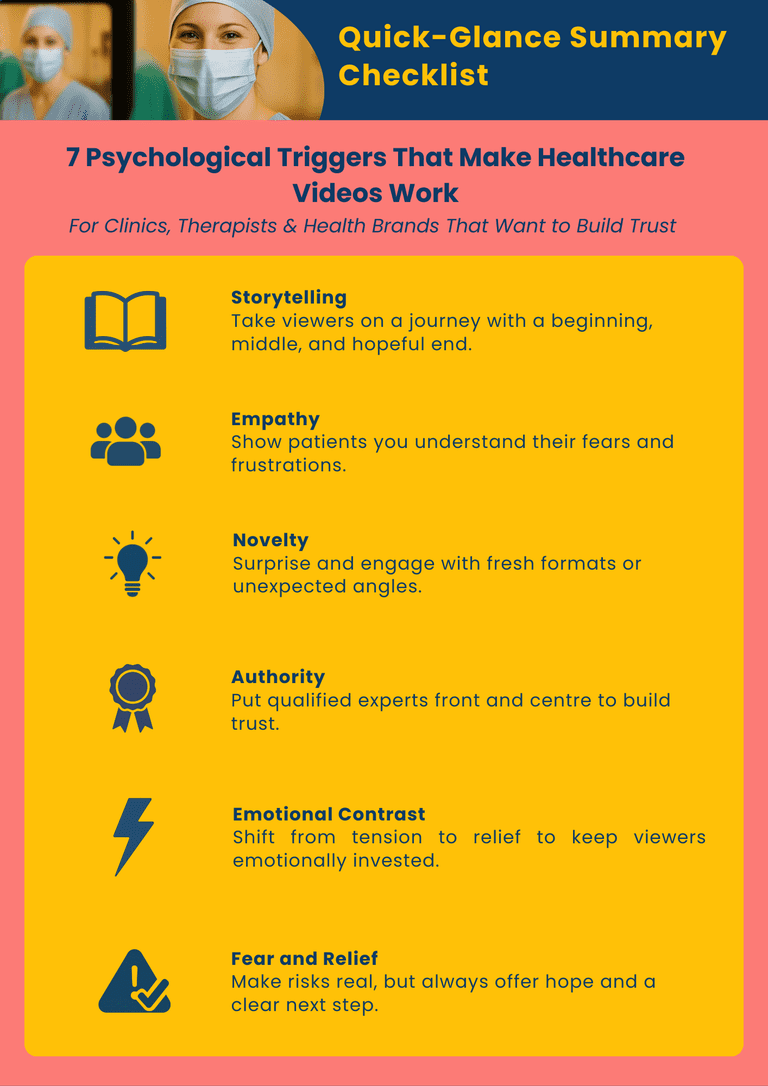
1. Storytelling: Why Your Video Needs a Beginning, Middle, and End (Not Just a Message)
Let me ask you something. When was the last time you watched a healthcare video that moved you?
The kind that made you lean in. Maybe even feel something.
Chances are, it followed a simple, timeless formula: the 5-act story structure.
You’ve seen this structure in everything from Netflix dramas to the best charity campaigns:
- Act 1: Meet the person with a problem
- Act 2: The problem gets worse
- Act 3: They hit a breaking point
- Act 4: They find help or take action
- Act 5: Life changes for the better
Why does this work? Because stories aren’t just entertainment. They’re how we process information.
Neuroscience shows that stories trigger oxytocin, the brain’s trust chemical.
When people feel a story, they’re more likely to trust the person telling it and take action.
Example
Bupa UK nailed this with their ‘Tooth Fairy’ campaign.
Instead of listing boring dental facts, they told a playful story about the tooth fairy visiting a child.
It felt human. It felt relatable. It racked up over 1 million YouTube views.
The NHS has used this too, remember the “70 Years of the NHS” campaign? They didn’t lead with stats or services. They shared real patient and staff stories. And the nation loved them for it.
How to Apply This in Your Videos
Don’t just explain your services. Tell a story. Here’s a simple structure you can steal:
- Act 1: Show a patient before treatment: worried, in pain, or unsure.
- Act 2: Build tension: What’s at stake if they don’t act?
- Act 3: Introduce your clinic or treatment as the turning point.
- Act 4: Show the journey: real faces, real voices, real progress.
- Act 5: End with hope: show the patient’s life transformed.
Visualante tip: Ditch the scripts. Let real people tell their real stories in their own words. By asking the right questions, you can reveal raw emotions that ‘shows’ their journey more than just ‘telling’ it. Yes, it means longer in the edit, but the extra effort is well worth it. Authenticity beats polish every time.
2. Empathy: Why ‘We Understand’ Might Be Your Most Powerful Message
Here’s what most healthcare marketers forget: Facts don’t build trust, feelings do.
If your video doesn’t make patients feel seen, they won’t stick around long enough to hear your message.
That’s where empathy comes in.
Empathy in video is about showing your audience, “We get it. We understand how you’re feeling.” It’s about meeting them where they are, scared, overwhelmed, confused, and showing them they’re not alone.
The Science of Empathy
When people feel understood, their trust barriers drop. They’re more likely to listen, engage, and act.
HubSpot calls empathy the ‘secret sauce’ of trust.
Psychology research shows that brands using empathetic messaging build stronger emotional connections than those that just list features or facts.
In healthcare, this matters more than ever.
Example
Look at how the NHS builds empathy in its mental health campaigns.
They don’t just say, “We offer services for anxiety and depression.”
They share real patient stories, stories of fear, struggle, and hope. Patients talking openly about how hard it felt before they got help.
It’s raw. It’s relatable. And it works. Because when patients see themselves in the story, they trust the people telling it.
How to Apply This in Your Videos
- Start with the patient’s perspective. Open your video by naming their fear or frustration. “Living with [condition] can feel scary and isolating, we understand how overwhelming it can be.”
- Use everyday, conversational language. Ditch the jargon. Talk like a real person, not a policy document.
- Show real people, not just clinicians. Let patients share how they felt before and after finding your help.
- Train your on-camera speakers to show warmth. Simple phrases like “You’re not alone” or “We’re here to help you through this” go a long way.
Remember, empathy isn’t a tactic, it’s a responsibility. If your video doesn’t show you care, why should patients care about you?
3. Social Proof: Show Prospective Patients They’re Not Alone
Ever read a review before booking a restaurant? Of course you have. We all do.
Now, imagine how much more nervous someone feels when choosing a surgeon or clinic.
That’s why social proof is one of the most powerful trust signals in healthcare. It reassures people they’re not the first to take the leap and they won’t be the last to benefit.
Why Social Proof Works
When we’re unsure what to do, we look to others for guidance. It’s called the bandwagon effect.
- 88% of people trust reviews as much as personal recommendations.
- Positive testimonials can increase enquiries by up to 82%.
So, if you’re not showing real people talking about their real experiences, you’re missing a massive trust-building opportunity.
Example
Take Christie NHS Foundation Trust. Their website is packed with video testimonials from patients sharing their recovery journeys.
Or think of the NHS Blood Donation campaigns:
“Last year, 5,000 lives were saved by blood donors like you.”
That’s social proof in action. It works because it makes people think, “If they can do it, so can I.”
Hearing real people talk about their treatment, in their own words, is far more persuasive than any clinical service list. This example of Christie’s patient Bob Huntbach talking about receiving immunotherapy treatment at home for his melanoma. Seeing him at home doesn’t just say “our service improves quality of life”, we see it through Biob’s story, he’s living proof.
How to Apply This in Your Videos
- Feature real patient stories on camera. Nothing builds trust like hearing “I was scared too… but this team changed my life.”
- Use specific, believable numbers. “Join 10,000 patients who’ve trusted us with their care.”
- Include on-screen text or graphics showing star ratings, Google reviews, or professional accreditations.
- Highlight endorsements from other professionals or trusted organisations. “Recognised by Macmillan Cancer Support for Excellence in Care.”
- Avoid corporate fluff. Real names, real faces, real voices, that’s what makes social proof work.
By the time someone finishes watching, they should feel “People like me have trusted them and it worked.”
That’s when you know you’ve earned the next click, call, or booking.
4. Authority: Why Viewers Trust Doctors Over Marketing Teams
It’s easy to overlook, but there’s one thing patients trust more than any marketing message. It’s not your logo that patients trust, it’s your experts.
When a qualified doctor, surgeon, or specialist speaks on camera, people lean in. Because in healthcare, credentials matter.
We’ve all seen it: “Dr. Smith, Consultant Cardiologist at Royal Free Hospital” And instantly, the message feels more legitimate.
That’s the authority trigger at work.
Why Authority Works
- 95% of people trust doctors more than government ads, media, or social media posts.
- Authority is one of the universal persuasion principles identified by Dr. Robert Cialdini.
But the key is:
Authority isn’t about sounding clever or using jargon. It’s about both showing competence and care.
Patients need to believe two things:
- “You care about me.”
- “You know what you’re doing.”
When your video shows both, you win their trust.
Example
Think back to the UK’s COVID-19 vaccine campaigns.
The Chief Medical Officer stood front and centre on national TV, calmly explaining the science.
Not marketers. Not politicians. Medical experts.
Why? Because that’s who the public needed to hear from to feel safe taking action.
Private clinics do this too. A spine clinic in London boosted consultations by putting their lead surgeon on camera, walking viewers through treatment options.
No sales pitch, just expertise, explained clearly and confidently.
A more recent example comes from NHS Lanarkshire, who released a short film featuring their Out of Hours Clinical Director, Dr. Mike Coates.
In the video, Dr. Coates calmly explains when stomach pain might be appendicitis and when to seek help.
It’s short, direct, and deeply reassuring because it’s coming from a trusted clinical leader.
Whether it’s an expert in a white coat or a patient sharing their lived experience, authority and authenticity work together to build trust.
How to Apply This in Your Videos
- Put your experts front and centre. Let doctors, nurses, or specialists speak directly to camera.
- Show credentials on screen. “Dr. Jones, Consultant Oncologist, 20+ years of experience.”
- Mention professional affiliations or awards. “Recognised by the Royal College of Surgeons.”
- Use clear, patient-friendly language. Authority isn’t about using big words. It’s about making complex information feel understandable and safe.
- Include real stats or evidence. “According to the British Medical Journal, this treatment is 90% effective.”
When patients see real experts, speaking with clarity and care, they’re far more likely to trust you with their health.
5. Emotional Contrast: The Power of the Rollercoaster
Think about your favourite film or TV show. Did it hold your attention because it was flat… or because it took you on an emotional ride?
In healthcare videos, it’s exactly the same.
If your message stays on one emotional note, whether it’s serious, sad, or positive, people tune out.
But if you build emotional contrast, tension and relief, fear and hope, struggle and success, you keep people hooked until the end.
Why Emotional Contrast Works
Our brains are wired to pay more attention when emotions shift. Psychologists call this the ‘peak–end rule’. We remember the most intense moment and the ending more than anything else.
It’s why a mother can go through the pain of childbirth but later describe it as “the best day of my life.”
The ending, holding her beautiful baby, is what her brain holds onto the most.
Or think about kids at the dentist.
The treatment might be uncomfortable, but that little sticker at the end? That’s what they remember, and that’s what makes them come back next time with less fear.
Your healthcare videos work the same way.
If you take patients on a journey from discomfort to relief, they’ll remember the hopeful resolution and feel good about trusting you with their care.
That’s why videos that take viewers from low to high (or fear to relief) stick in their memory.
It’s also why campaigns that only focus on facts or only feel uplifting often fail to land emotionally.
Example
The British Heart Foundation’s CPR ads are a masterclass in emotional contrast.
They start with fear:
A person collapsing, a life on the line. Viewers feel the panic. The urgency.
But then, they shift to hope: A bystander steps in. A life is saved. The viewer feels relief and empowerment.
That emotional journey is what drives action, in this case, people learning CPR.
How to Apply This in Your Videos
- Start with the struggle. Show the pain, fear, or frustration your patient faced before finding help.
- Build to the breakthrough. Show the turning point, meeting your team, starting treatment, and making progress.
- End on a high. Show life after treatment. The relief, the hope, the transformation.
- Use music and pacing to amplify the emotional shifts. Move from tense to uplifting, and help the viewer feel the journey.
Visualante tip: Always bring it back to the viewer. Make them think, “That could be me… and I could feel that relief too.”
If your video feels flat, you miss the emotional journey patients need to care and act.
6. Novelty: Make Viewers Say “I Didn’t Expect That… But I’m Glad I Watched”
Let’s face it: Most healthcare videos look and feel the same.
Safe. Predictable. Forgettable.
But here’s the thing: If you want people to stop scrolling, you have to give them something they don’t expect.
That’s the power of novelty, the brain’s built-in ‘pay attention’ button.
Why Novelty Works
Our brains are hardwired to light up when we see, hear, or experience something new. That ‘surprise’ triggers dopamine, which makes us feel good and pay closer attention.
Novelty also boosts memory. If your video looks or feels different to anything else your audience has seen, it sticks.
That doesn’t mean being gimmicky. It means adding something fresh, a surprising story, a creative format, or a twist that keeps viewers curious.
Example
University College London Hospital took a TikTok-inspired approach by posting day-in-the-life videos of real NHS staff, paramedics, nurses, and doctors.
These short, raw, vertical videos gave the public an inside look at healthcare workers’ daily routines.
Viewers loved the authenticity and behind-the-scenes feel. Proof that sometimes, a phone and a fresh perspective is all you need to stand out.
How to Apply This in Your Videos
- Use unexpected visuals or metaphors. Could you explain a health condition with animation? Could you frame your video like a mini documentary, game show, or even a patient’s day-in-the-life?
- Try fresh formats. Think 360° tours, TikTok-style edits, or behind-the-scenes glimpses your audience doesn’t normally see.
- Tell stories from surprising angles. What if the therapy dog narrated the video? What if the clinic tour felt like a movie trailer?
- Break the talking-head pattern. Use movement, cuts, or sound to surprise and delight viewers.
The trick is to stay relevant while breaking the expected pattern.
Because when viewers think, “I didn’t see that coming… but I’m glad I watched,” you’ve won their attention, and their trust.
7. Fear and Relief: How to Motivate Action Without Scaring People Away
Why Fear and Relief Works
Example
How to Apply This in Your Videos
- Start by naming the real risk. “1 in 3 people will develop cancer in their lifetime.”
- Make it personal. “Could it be growing inside you right now, without symptoms?”
- Then offer immediate hope. “But here’s the good news: early screening can catch it before it’s too late.”
- Use visuals to shift the mood. Start with darker, more serious imagery… then move to bright, hopeful scenes showing patients taking positive action.
- Give a clear next step. “Book your free screening today, your future self will thank you.”
When done ethically, this approach wakes people up but leaves them feeling empowered, not paralysed.
Because when your video makes someone think,
“That could happen to me… but I’m so glad there’s something I can do about it,” You’ve moved them, and that’s what leads to action.
It’s Not Just About Video, It’s About Psychology
If you want your healthcare videos to do more than just exist, if you want them to build trust, spark emotion, and drive action, you can’t rely on information alone.
You have to trigger something deeper in your audience.
These seven psychological triggers aren’t gimmicks. They’re proven behavioural drivers that help patients feel seen, safe, and ready to act.
By weaving these into your next campaign, you’ll stop making “just another healthcare video”… …and start creating stories that stick, build trust, and change lives.
So, what’s the first small change you’ll make in your next video?
Ready to Turn These Triggers Into Real Video Strategy?
Let’s chat about how to apply these techniques to your next campaign.
Book a free strategy call with Visualante Creative today.